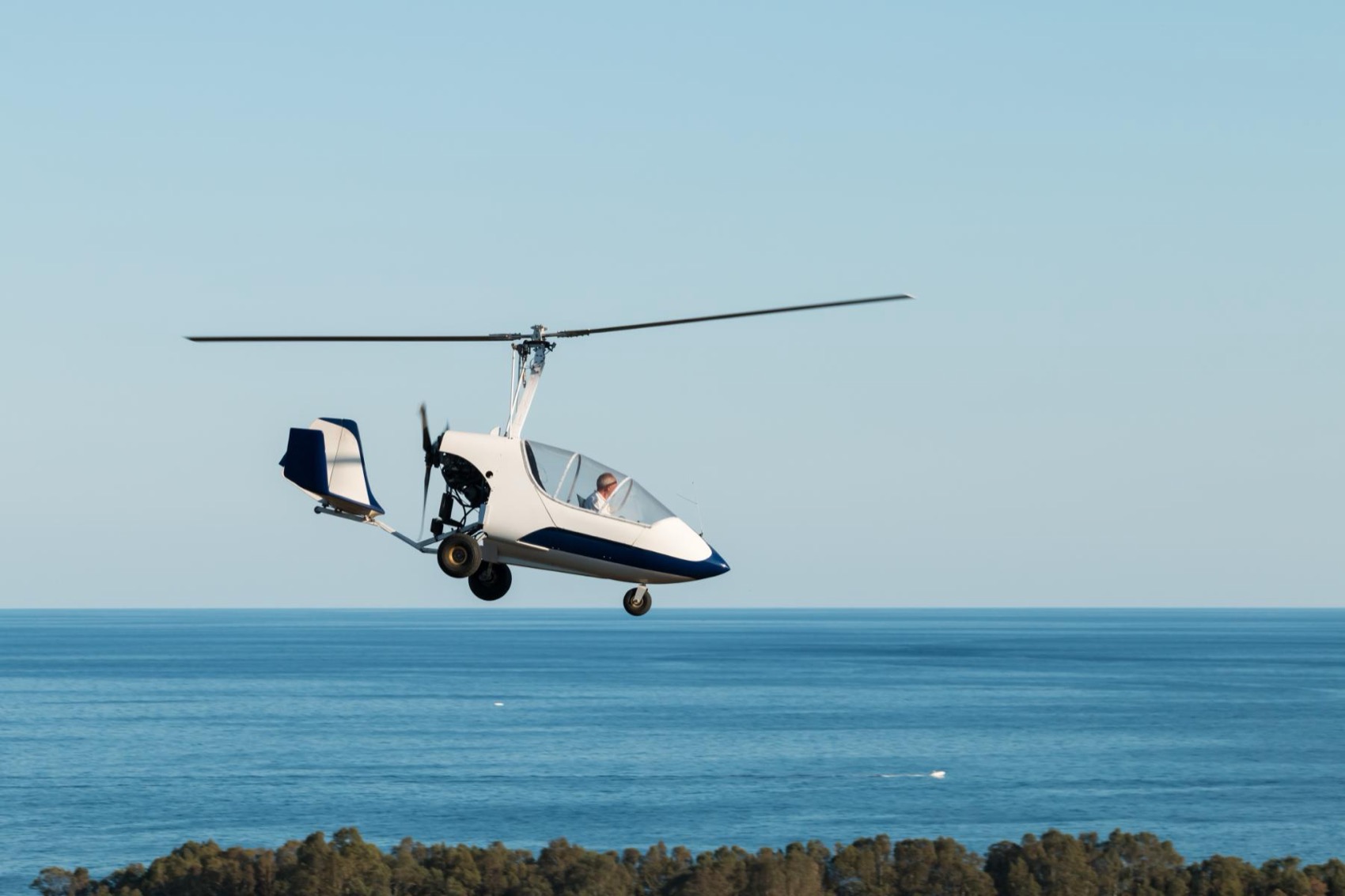
People ask this one directly, and it deserves a direct answer, not a dodge. There is no single, apples-to-apples accident-rate statistic spanning gyrocopters, helicopters and airplanes. The three fleets fly different missions, in different eras of design, in wildly different numbers, so a clean scoreboard does not exist. What does exist are specific, real structural differences between how each aircraft fails, and those are worth stating plainly instead of guessing at a single winner.
The honest differences
- A gyrocopter has no fixed-wing style stall or spin in normal flight.
- Its engine-out response is already the aircraft's normal flight mode, not a separate emergency skill.
- Its rotor system is mechanically simpler than a helicopter's, with no swashplate.
- A helicopter can hover and back up in ways a gyrocopter genuinely cannot, which is a capability gap, not a safety score.
Against an airplane: no stall, no spin
A fixed-wing stall, and the spin that can follow an uncoordinated one, sits near the top of general aviation's fatal accident causes. A gyrocopter's rotor makes its own airspeed by turning, so it keeps producing lift at forward speeds where an airplane's wing would already have stopped flying. That single structural fact removes an entire accident category instead of merely reducing its odds. It also needs little to no runway, which removes another common airplane accident type, the runway excursion, almost entirely. We cover the aerodynamics behind this in how a gyrocopter works and can a gyrocopter hover.
| Failure mode or trait | Airplane | Helicopter | Gyrocopter |
|---|---|---|---|
| Low-speed stall or spin | A leading cause of fatal accidents | Not applicable in the same way | Not present in normal flight |
| Engine failure response | Glide to a landing site, no power | Autorotation, a trained emergency skill | Autorotation, the aircraft's only flight mode |
| Rotor or wing mechanism | Fixed wing, no moving control surface linkage of this kind | Swashplate, cyclic and collective | Teetering rotor, no swashplate |
| Hover in place | Cannot | Yes | Cannot, beyond a brief jump takeoff |
Against a helicopter: simpler, and always in the same mode
A helicopter pilot trains for autorotation as an emergency procedure, practised periodically and executed under real time pressure if the engine ever actually quits. A gyrocopter pilot is already flying that same regime on every single flight, since the rotor is never engine-driven in the air. There is no unfamiliar mode to drop into if the engine stops, only a continuation of what the aircraft was already doing. Mechanically, a gyrocopter's teetering rotor also has no swashplate, the linkage a helicopter uses to tilt its rotor disc through cyclic and collective control. Fewer moving parts in that chain is fewer places for a control-system failure to start. The full spec-by-spec comparison is in gyrocopter vs helicopter.
None of this makes a gyrocopter simply better. A helicopter can hover motionless, sidestep, and back into a tight space, none of which a gyrocopter can do at all, since its rotor only ever produces lift while air is moving up through it. That is a genuine capability difference, and it exists for real missions, search and rescue among them, where nothing else will do the job.
What the gyrocopter side of the ledger does not get to skip
We are not going to claim a clean safety record for the whole category either. Early gyrocopters carried a real design flaw, a propeller thrust line set high above the centre of gravity with little or no horizontal stabiliser, and it killed people in a way that had nothing to do with helicopters or airplanes at all. Modern factory designs have that flaw engineered out. The honest, sourced account of that history, and what changed, is in are gyrocopters safe, and the same question applied to specific manufacturers is in safest gyrocopter manufacturer.
The honest bottom line
Ask which category is safest and you are asking the wrong question, because the number that would answer it does not exist in a form worth trusting. What actually predicts safety, in any of the three, is the same short list every time: a modern design with the failure modes of its category engineered out, a pilot who trains and stays current in it, and an aircraft that is properly maintained. Category matters less than those three things, and no aircraft, gyrocopter, helicopter or airplane, gets to skip any of them.
See the real numbers side by side
Compare gyrocopter models on published specifications, or find an instructor to fly one yourself before you take anyone's word for it.
Report inaccurate information. This page mixes public data with our own notes. Tell us what looks off and we will check it.