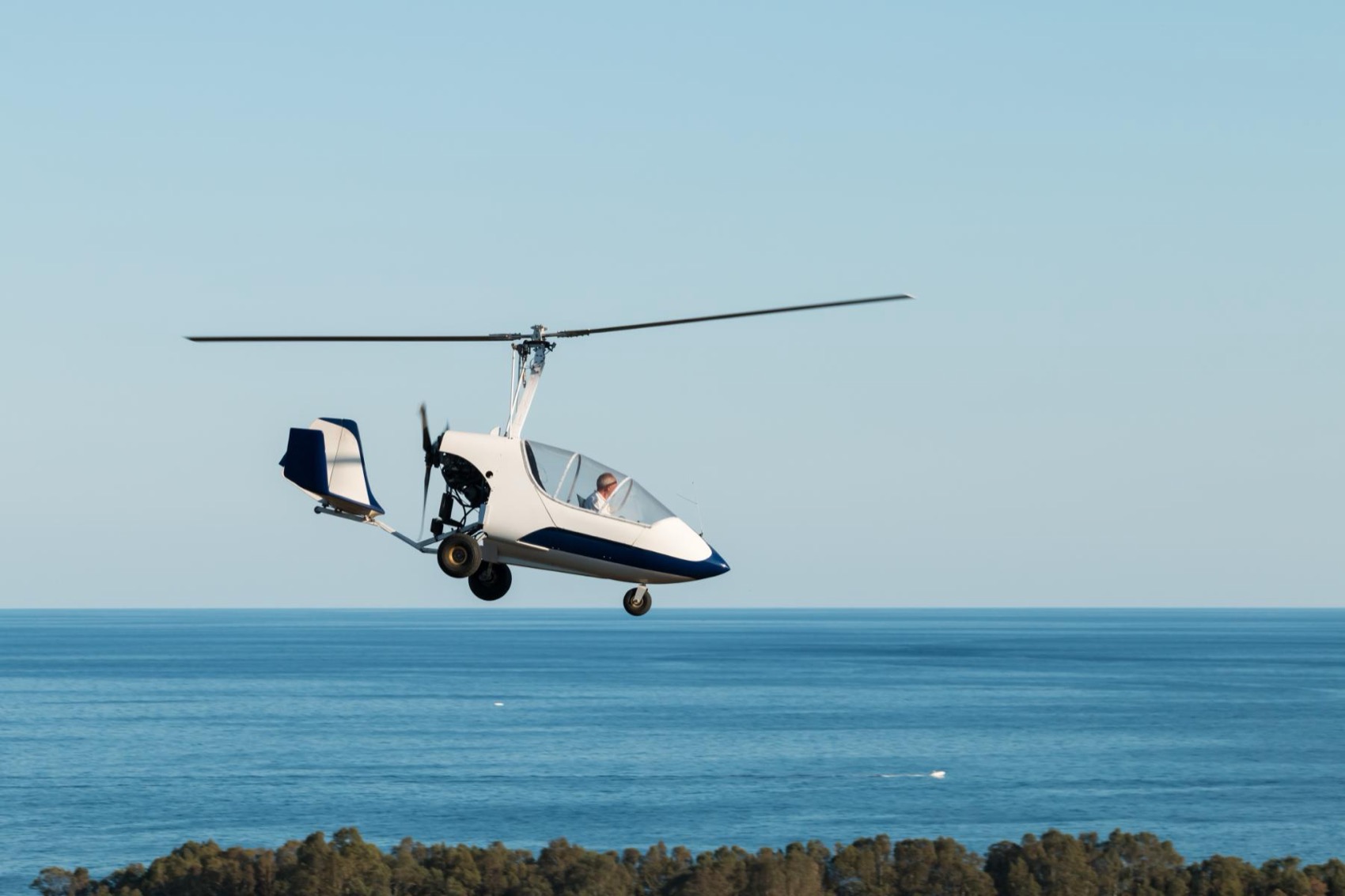
People expect a gyrocopter to work like a small helicopter, and then the explanation confuses them, because it does not work like one at all. The single idea that makes sense of the whole aircraft is this: the engine does not turn the rotor. Once that lands, everything else about how the machine flies follows from it.
I read manufacturer spec sheets and pilot reports all day for this site. Here is the mechanism, part by part, in the order it actually happens on a flight.
The mechanism in four lines
- The overhead rotor is the wing. It is not powered in flight.
- Air flowing up through the tilted disc keeps the rotor spinning. That is autorotation.
- A separate engine and propeller provide the forward push.
- Because the rotor always turns, a gyrocopter cannot stall, and an engine failure is a glide, not an emergency descent.
The rotor is the wing, and nothing drives it
On an airplane the wing is fixed and the whole aircraft moves through the air to make lift. On a gyrocopter the wing spins. The rotor does the same job a wing does, but it generates its lift by turning, not by the airframe rushing forward at speed. What matters is that in normal flight no engine, belt or shaft is connected to that rotor. It turns on its own. Feel the difference from a helicopter here, because it is the whole story: a helicopter forces its rotor round with engine power and has to counter the twisting reaction with a tail rotor. A gyrocopter has no such reaction to fight, so it carries no tail rotor.
How the rotor gets spinning before takeoff
A stationary rotor makes no lift, so you have to get it turning first. Modern machines use a pre-rotator, a small electric or hydraulic drive geared to the rotor head, to spin the blades up while you sit still on the ground. That gets the disc to a few hundred rpm, enough to start, not enough to fly.

Why the rotor keeps spinning in the air
Now you roll forward under propeller thrust with the rotor disc tilted back a little. Air meets the underside of the disc and flows up through it. That upward flow strikes each blade at an angle that keeps dragging the rotor round, faster and faster, until it reaches flying speed on its own. This is autorotation, and it is self-sustaining as long as air keeps passing up through the disc. Stop the forward motion and the driving airflow stops with it, which is exactly why the aircraft cannot hover.
What each part is actually doing
| Part | On a gyrocopter | On a helicopter |
|---|---|---|
| Rotor | Turned by airflow, makes lift | Driven by the engine, makes lift and thrust |
| Engine | Turns a propeller only | Turns the main and tail rotors |
| Propeller | Provides all forward thrust | None |
| Tail rotor | None needed | Counters engine torque |
| Pre-rotator | Spins the rotor up for takeoff | Not used |
Why it will not stall
An airplane wing stalls when it meets the air at too steep an angle and the smooth flow breaks away. A gyrocopter rotor never faces that problem, because the blades keep autorotating regardless of how slowly the aircraft is moving. Slow right down and the machine simply descends faster, wings still flying, fully controllable. That is the trait that makes these aircraft calm in gusty air and forgiving at low speed.
One caution, because it is where the "forgiving" reputation ends. The rotor stays your friend only while it stays loaded, meaning while it is carrying the aircraft's weight. Unload it with an abrupt push, most often near the ground, and you can lose the very airflow that drives it. That mechanism is behind the accidents worth understanding before you fly.
What happens when the engine quits
This is the part that sells a lot of people on the aircraft. Lose the engine in a gyrocopter and nothing sudden happens to the rotor, because the engine was never driving it. The rotor keeps autorotating on the air now flowing up through it as you glide down, and you land it much as you would a normal approach, just without power. A helicopter pilot has to react in a second or two to enter autorotation after an engine failure. A gyrocopter is already there. It is worth reading how that plays out in the plain overview of the aircraft, and the risks that remain are covered honestly in 4 reasons gyrocopters crash.
Go see one spin up in person
Reading how it works only gets you so far. Find a school, watch a pre-rotation and takeoff from a few feet away, and take a demo flight before you decide.
Report inaccurate information. This page mixes public data with our own notes. Tell us what looks off and we will check it.