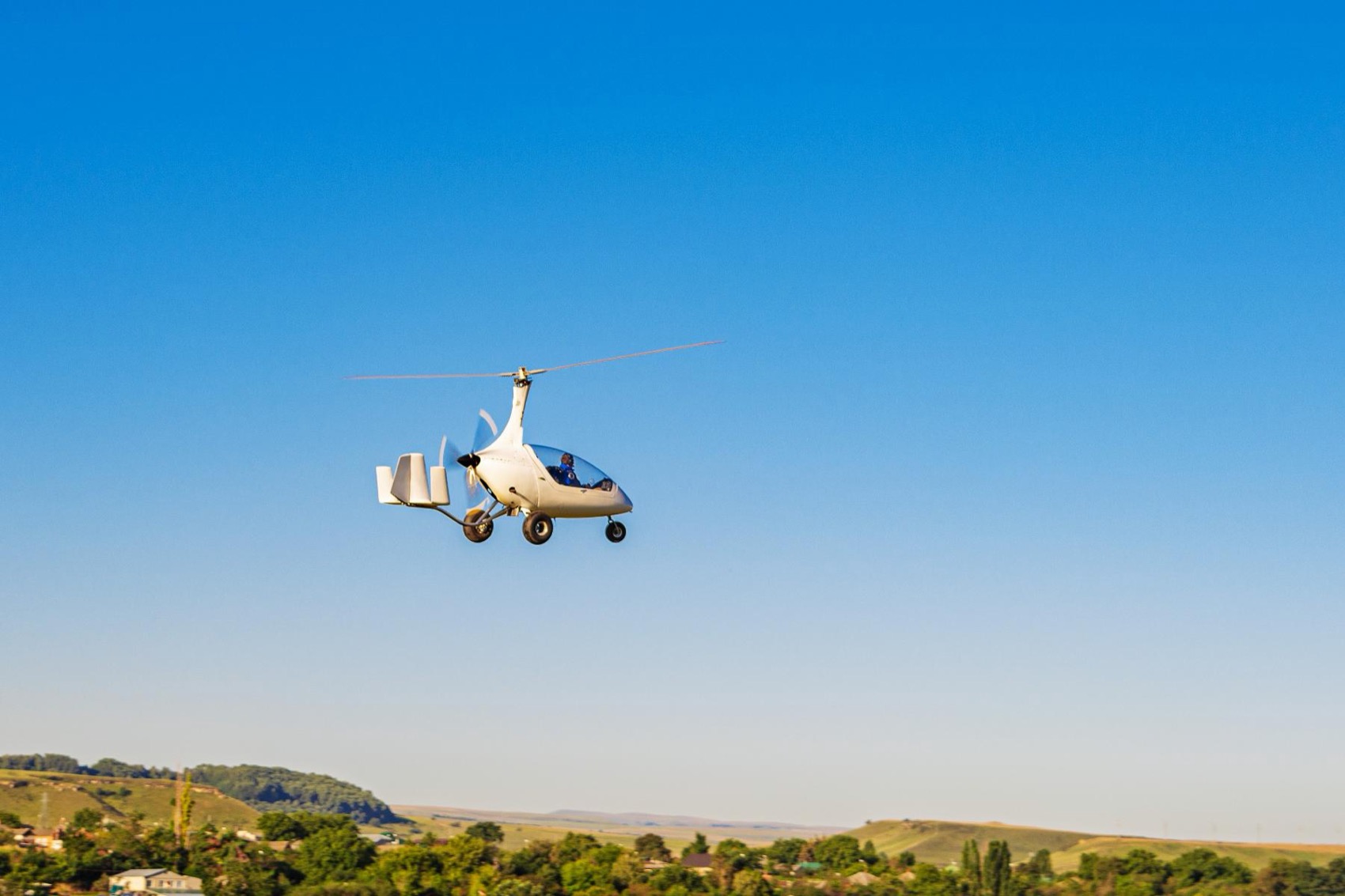
Most people who ask me about gyrocopters start from the same wrong place: they think they are looking at a cheap helicopter. They are not, and clearing that up early saves real money and a lot of confusion. A gyrocopter flies on a principle almost nobody guesses right the first time, and once it clicks, the rest of the aircraft makes sense.
I run the manufacturer directory on this site, so I read the spec sheets and the sales copy for a living. Here is the plain version, without the brochure language.
The short version
- A gyrocopter has an unpowered rotor that spins on its own. The engine drives a propeller, not the rotor.
- It cannot hover, and it cannot stall. Those two facts explain most of how it flies.
- Gyroplane, gyrocopter and autogyro are the same machine under three names.
- A new two-seater runs roughly $70,000 to $150,000, well under half the price of a comparable helicopter.
A gyrocopter is not a small helicopter
The rotor on top spins freely. The engine does not turn it. Instead the engine drives a propeller, usually mounted at the back in a pusher layout, and that propeller pushes the aircraft forward. As it moves, air flows up through the tilted rotor disc and spins the blades on their own. That effect is autorotation, and it is the whole trick. A helicopter powers its rotor and can hang motionless over one spot. A gyrocopter cannot, because the second it stops moving forward, the air stops driving the rotor.
One consequence falls straight out of that. Because nothing drives the rotor in flight, there is no engine torque to fight, so a gyrocopter needs no tail rotor. No tail rotor, no main transmission, no collective. That is why these machines are mechanically simpler than a helicopter of the same size, and cheaper to run by a wide margin.
The one fact that clears up most arguments: a gyrocopter cannot hover. When someone tells you theirs "hovers," they mean they are flying slowly into a stiff wind until the groundspeed drops to zero. The rotor still needs air moving through it. No airflow, no lift, no exceptions.
One machine, three names
Before you shop, know that the same aircraft goes by three names, and if you search only one you miss most of the market. Juan de la Cierva flew the first successful one in 1923 and called it the Autogiro. Igor Bensen sold thousands of homebuilt kits in the 1950s under his coined word, Gyro-Copter. Your FAA paperwork, meanwhile, says gyroplane. Same machine every time. I wrote a whole piece on where each name came from in gyroplane vs gyrocopter, so I will not repeat it here.
How it compares to what you already fly
| Trait | Gyrocopter | Helicopter | Fixed-wing airplane |
|---|---|---|---|
| Rotor driven by engine | No, it autorotates | Yes | No rotor |
| Can hover | No | Yes | No |
| Can stall or spin | No | Not applicable | Yes |
| Takeoff roll | Short, often a few hundred feet | None | Longer |
| New two-seat price | About $70k to $150k | About $300k and up | About $150k and up |
What it will not do, and what that buys you
A gyrocopter will not stall. Slow it down and the rotor keeps autorotating regardless. Fly it too slow and you simply sink faster, still under full control, instead of dropping a wing the way an airplane does. That single trait is why pilots call these machines forgiving in slow flight and in gusty wind, and it is genuine.
Forgiving is not foolproof, though, and I will not pretend otherwise. A gyrocopter has its own failure modes, and they catch out pilots who arrive with airplane reflexes. If you want the honest version of that, I wrote it up in 4 reasons gyrocopters crash. Read it before you fall for anyone selling these as effortless.
What people actually use them for
The honest answer is that most gyrocopters fly for fun. Low, slow, open-cockpit sport flying is the heart of the market. Past recreation you will find them training new pilots, shooting aerial photography, patrolling pipelines and power lines, and doing light observation work over farmland. Seating is one or two people. Some, like the open Magni M16 or the AutoGyro MTOsport, leave you out in the airflow. Others, like the enclosed Cavalon, seat you side by side behind a windscreen with a heater. Most modern examples run a Rotax engine making 100 to 140 horsepower and burn car-like fuel, not jet fuel.

If you must hover, buy a helicopter. For almost everything else, low and slow or a surprisingly quick cross-country in a faster model, a gyrocopter covers more ground per dollar than anything else with a rotor.
Is it the right aircraft for you?
Sort yourself out honestly. If none of what a gyrocopter gives up bothers you, and flying low, slow and cheap for its own sake is the point, this is the aircraft that earns its keep, and little else touches it on cost of entry.
So that is the machine. An unpowered rotor, a separate engine for thrust, no hover, no stall, a short takeoff roll, and a price that undercuts a helicopter by more than half. If it suits you, the next questions are cost and licensing, and I have written up both.
See real machines and real prices
Browse gyrocopters for sale from owners and dealers, or find a school near you and go fly one before you spend a dollar buying.
Report inaccurate information. This page mixes public data with our own notes. Tell us what looks off and we will check it.