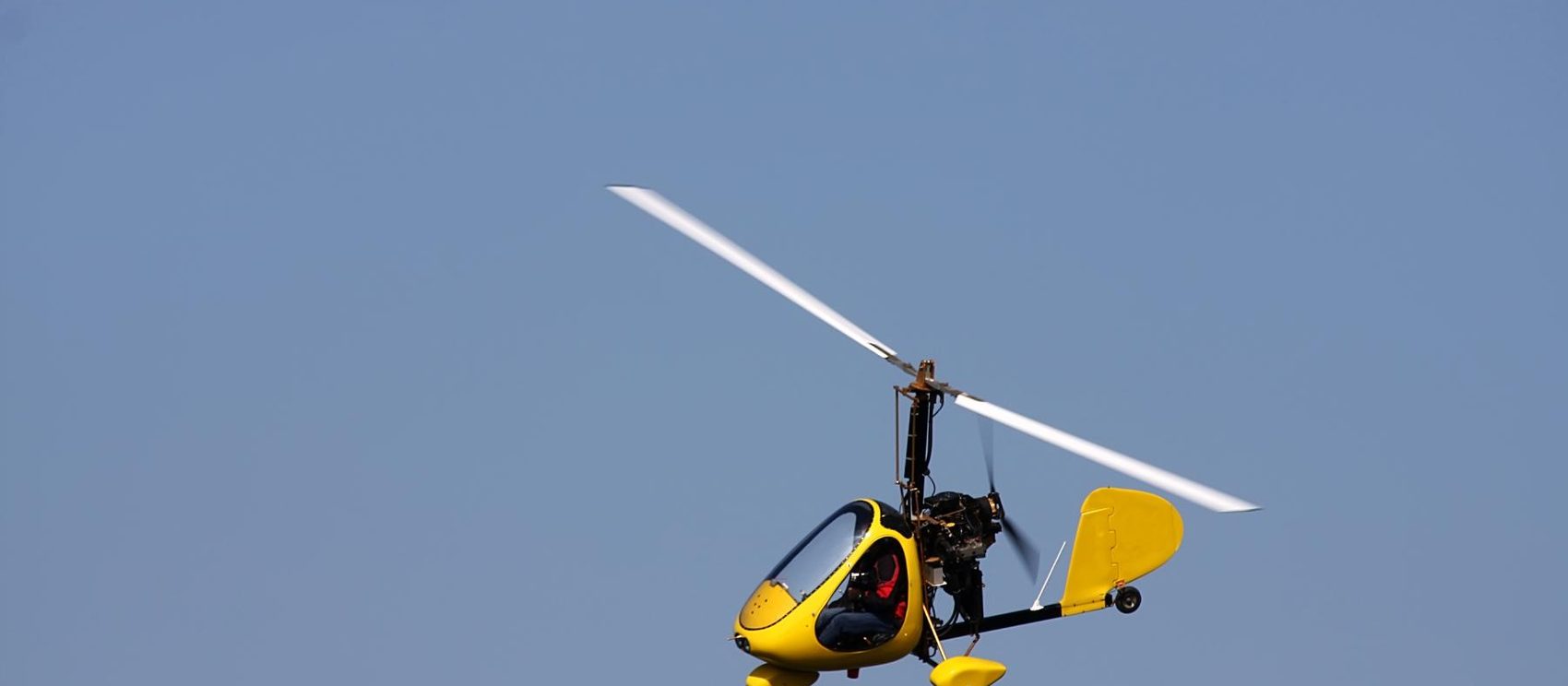
Put a gyrocopter and a helicopter side by side and most people see two versions of the same idea: a machine that flies on a spinning rotor. There is one difference underneath, and it decides almost everything else. On a helicopter the engine drives the rotor. On a gyrocopter it does not. Hold onto that and the rest of the comparison falls into place.
The difference that decides the rest
- Helicopter: the engine powers the rotor, so it can hover and take off straight up.
- Gyrocopter: airflow powers the rotor, so it cannot hover but is far simpler and cheaper.
- Engine failure favours the gyrocopter, which is already gliding on its rotor.
- For lifting, hovering work, a helicopter wins. For low-cost sport flying, the gyrocopter wins.
The one difference, drawn
What the difference costs and buys
Because a gyrocopter never drives its rotor, it does away with the expensive, heavy hardware a helicopter must carry: the main transmission that handles engine torque, the tail rotor and its gearbox, and often the turbine engine itself. Strip those out and you get an aircraft that is dramatically cheaper to buy, to insure and to maintain, and that sips automotive fuel instead of jet fuel.
| Gyrocopter | Helicopter | |
|---|---|---|
| Hover | No | Yes |
| Vertical takeoff | No, short roll | Yes |
| Cost to buy and run | A fraction | Much higher |
| Engine failure | Already autorotating | Must enter autorotation fast |
| Best at | Low, slow, cheap sport flying | Lifting and hovering work |
Why the helicopter costs so much more
The price gap is not a brand premium, it is hardware. A helicopter's engine power reaches the rotor through a main transmission built to carry full torque, a component that is heavy, precisely made, and expensive to overhaul on a schedule. Then comes the tail rotor with its own gearbox and driveshaft, effectively a second rotor system to buy and maintain. Many helicopters add a turbine engine on top of that, thirsty for jet fuel and costly to run to time. A gyrocopter carries none of it. Delete the transmission, the tail rotor and the turbine, and you delete most of the purchase price, most of the maintenance bill, and most of the fuel cost in a single stroke.
What each aircraft is actually for
Mission sorts them faster than any spec sheet. A helicopter earns its keep where hovering and lifting are the job: rescue and air ambulance work, construction and power-line jobs, and landing in a space no runway could serve. If the task needs the aircraft to stop in mid-air and stay there, only the helicopter can do it, and the cost is the price of that ability. A gyrocopter is built for a different day: low, slow flying for its own sake, patrol and observation over farmland or pipeline, flight training, and getting in and out of short strips. It will not do the helicopter's heavy work, and it was never meant to.
Which one is safer
This is where people want a clean winner, and there is not one. The gyrocopter has a genuine edge after an engine failure, because the rotor is already autorotating and the aircraft simply glides down, while a helicopter pilot has a second or two to react. It also cannot stall. Against that, a gyrocopter punishes airplane reflexes with failure modes of its own. Neither aircraft is safe or dangerous on its own; the pilot's training decides it. I go into the gyrocopter side honestly in are gyrocopters safe.
If your reason for looking at helicopters is the cost of learning to fly one, read this before you commit. A gyroplane rating is usually a fraction of the cost per hour, for reasons that come straight from the missing transmission and tail rotor. We lay the two paths side by side in how to get a helicopter license.
How they feel to fly
Pilots who move between the two describe them as different disciplines, not a harder and an easier version of one skill. A helicopter demands constant, precise attention to hold a hover, a tail rotor to coordinate, and a fast hand if the engine quits. A gyrocopter asks for none of that hovering workload, but it punishes the airplane habit of shoving the nose down and rewards a pilot who keeps the rotor loaded and the inputs smooth. Neither is casual. Both take real training, and the skill does not transfer cleanly in either direction.
Choose in one line
- Need to hover, lift, or reach places without a runway? Helicopter, and budget accordingly.
- Want the cheapest, calmest way to fly low and slow for the joy of it? Gyrocopter.
- Worried about engine failure above all? The gyrocopter is already gliding on its rotor.
The best comparison is an hour in each
Numbers only get you so far. Fly a gyroplane, and fly a helicopter if you can, then decide. Our directories list who teaches both.
Report inaccurate information. This page mixes public data with our own notes. Tell us what looks off and we will check it.