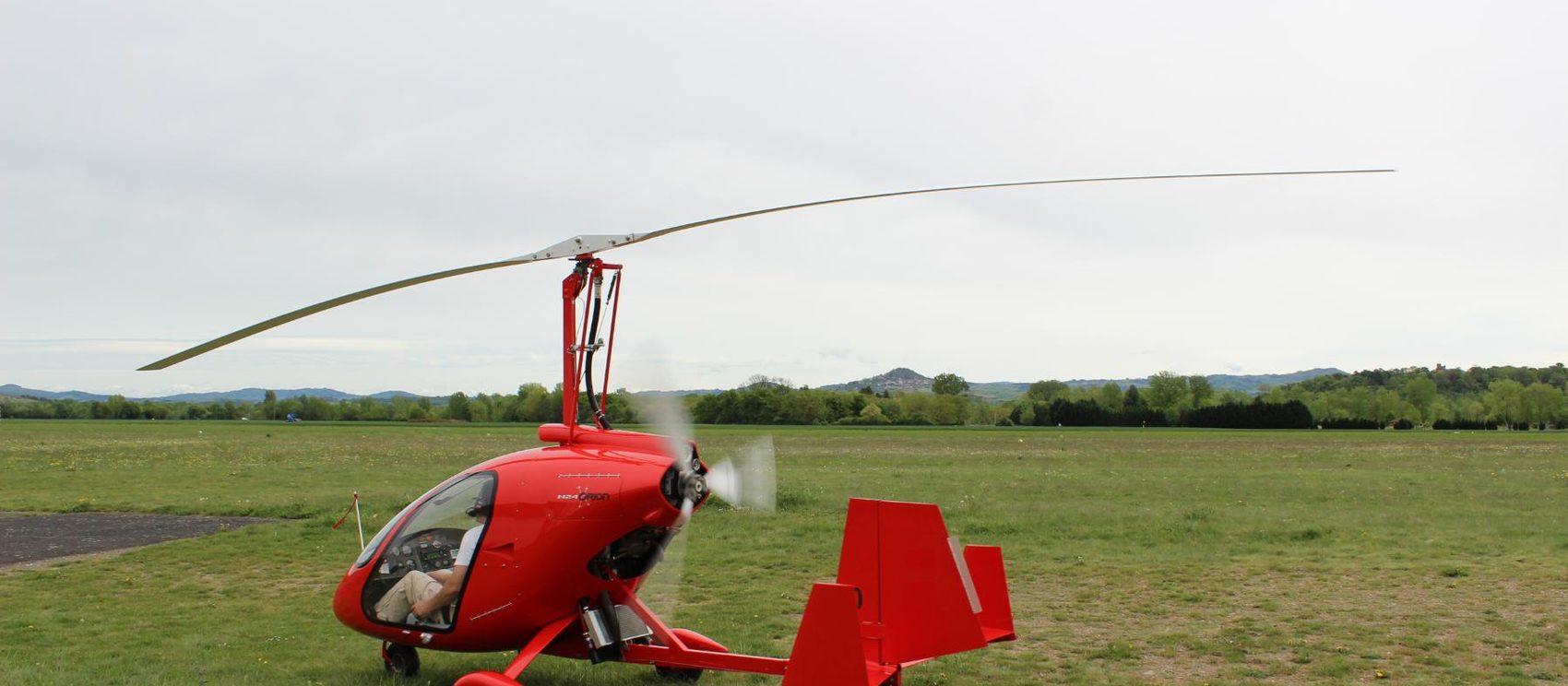
If you are searching this, you have probably already found a flight school price list and had a small shock. Here is what the certificate actually involves, and then the thing most people searching this question do not know: there is a second kind of rotorcraft that costs a fraction as much to fly, and a lot of helicopter students end up in one.
The short version
- A helicopter rating is its own category and class. Aeroplane hours count toward your total, not toward the handling.
- Almost nobody finishes at the regulatory minimum, so the minimum is a floor and not a budget.
- A gyroplane is the other rotorcraft. Simpler machine, no transmission, no tail rotor, far cheaper per hour.
- It is not an easier aircraft. It is a different discipline, and one specific failure mode catches people out.
How to get a helicopter license
-
Take a discovery flight first
An hour with an instructor tells you whether you actually want this before you have spent anything meaningful. Do this before you buy a headset, a logbook, or a training package.
-
Get the medical sorted early
Class of medical depends on what you intend to do with the certificate, and it is the one step that can stop everything. Find out where you stand before you commit to a school.
-
Choose a school and ask the honest question
Not what the minimum hours are. Ask what their students actually average, and what the all-in figure has been for the last few people who finished. Any school worth training with will tell you without being pushed.
-
Ground school alongside, not after
The written material does not need aircraft time. Studying it in parallel keeps expensive hours for handling rather than for things you could have learned at a kitchen table.
-
Fly consistently
This is where the money goes. Long gaps mean re-learning, and re-learning is billed at the same rate as learning. Two lessons a week finishes for less than one lesson a fortnight, even though the hourly rate is identical.
Hour minimums are set by regulation and depend on which certificate you are after and which country you are in. Your national authority publishes them and they change, so we are not reprinting numbers here that might be a revision out of date by the time you read this. What does not change is that the minimum is a floor almost nobody lands on.
The number that matters is not the hourly rate. It is how many hours you actually fly, and that is decided by how often you show up.
The part most people searching this never find out
A helicopter is not the only rotorcraft you can learn to fly. A gyroplane is the other one, and for a lot of people it turns out to be what they actually wanted: a machine that takes off and lands in a small space, flies low and slow with a genuinely open view, and costs a fraction as much per hour.
The saving is structural, not a discount, and it comes from three things at once. There is no swashplate, no tail rotor gearbox, no collective. The rotor is unpowered, so there is no main transmission carrying engine torque. And most gyroplanes run modest four-cylinder engines rather than turbines, so fuel burn is closer to a light aeroplane than a helicopter.
That last point is worth sitting with. Nothing drives the rotor in flight. Air passing up through the disc keeps it turning, continuously, which is the same fact that makes an engine failure a controlled descent rather than a crisis. We explain the mechanism in what is autorotation.
Helicopter or gyroplane
| Gyroplane | Helicopter | |
|---|---|---|
| Rotor in normal flight | Turned by airflow | Driven by the engine |
| Main transmission | None | Yes, carrying engine torque |
| Tail rotor | None | Yes, on most types |
| Hover in still air | No | Yes, under power |
| After engine failure | Already autorotating | Must transition to autorotation |
| Typical engine | Four-cylinder piston | Large piston or turbine |
| Catches people out | Keeping the rotor loaded | Hover and autorotation entry |
Before you switch, read this part
You will see gyroplanes sold as easier to fly. Narrowly that is fair: no hover to hold, no tail rotor to coordinate. As a general claim it is misleading, and this is the paragraph to read twice.
A gyroplane demands a specific discipline a helicopter does not: keeping the rotor loaded. Unload it, particularly with power applied, and you can enter a power push over. It appears repeatedly in accident reports, it is unforgiving, and aeroplane hours do not prepare you for it.
It is a different skill, not a smaller one. Anybody selling it to you as easy is selling.
What a gyroplane costs to buy
Two routes, and the terminology gets muddled. A kit is cheaper in cash and expensive in time and skill, and build quality varies with the builder, which is why who assembled a used airframe is worth asking about. A factory-built aircraft arrives complete: you pay more and get a known quantity.
There is no such thing as an FAA-approved manufacturer. Airworthiness categories attach to an individual airframe and the country it is registered in, not to the company that built it. The same factory aircraft can be certified in Europe and registered as Experimental in the United States. When somebody tells you a brand is approved, ask which aircraft, in which country, under which category.
Work out what it would actually cost you
Our financing page explains what a lender asks for, and has a calculator that runs on your own figures rather than an industry average.
What to do next
Fly both if you can. An hour in each tells you more than any comparison, including this one. Our instructor directory and flight school directory list who teaches gyroplanes, and both are free to search.
If you are still deciding, the ground school and the knowledge quiz cost nothing, and every answer in them links back to the page it came from so you can check our working.
Report inaccurate information. This page mixes public data with our own notes. Tell us what looks off and we will check it.