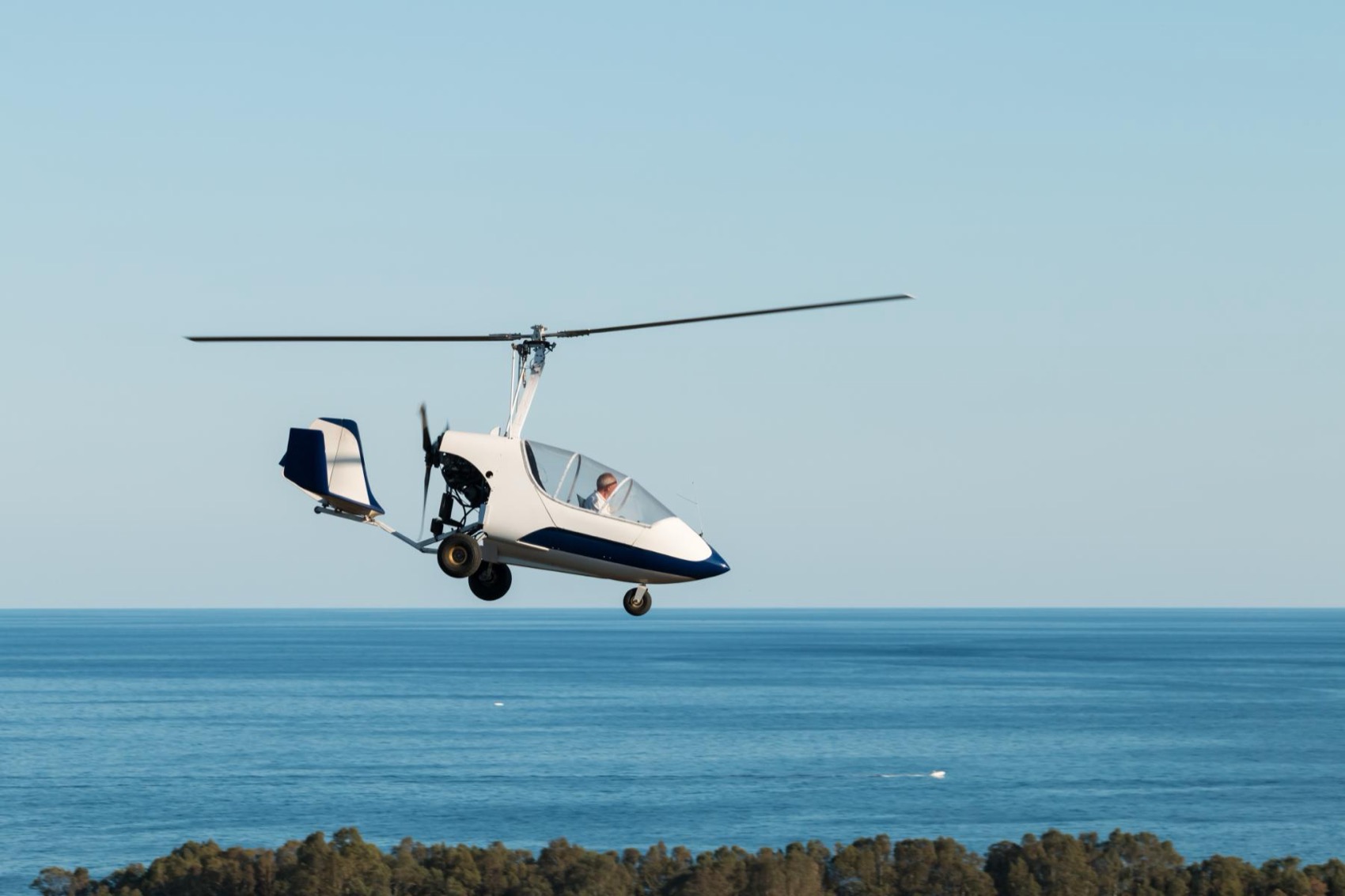
If the engine quits in a gyrocopter, almost nothing dramatic happens in the first second, and that is the whole point of the aircraft. The rotor keeps turning because the engine was never driving it, the machine keeps flying, and you glide down and land. It is the calmest engine-failure story in light aviation, and it is a large part of why people who fly these machines trust them.
The short version
- The rotor is already autorotating, so an engine failure does not stop it flying.
- There is no urgent action needed just to keep the rotor turning, unlike in a helicopter.
- A gyroplane glides down under full control and lands with little or no roll.
- The glide is steep, roughly four feet forward for every one down, so you land near where you are.
Why nothing sudden happens to the rotor
On most aircraft, engine failure changes the flying immediately. On a gyroplane it does not touch the thing that keeps you up, because the engine only ever drove the propeller, not the rotor. Air flowing up through the disc is what spins the rotor, and that airflow continues as you glide, so the rotor keeps making lift exactly as it did a moment earlier. There is no rotor to save, no critical few seconds to react in. You lose thrust, the aircraft begins a gentle descent, and you fly it down. The mechanism is spelled out in how a gyrocopter works.
The one number to understand: the glide
A gyroplane is not a good glider, and that is worth being honest about. Its glide ratio is roughly four to one, meaning it travels about four feet forward for every foot it descends, far less than an airplane and nothing like a sailplane. The practical effect is that you come down at a fairly steep angle and cannot stretch the glide to a distant field. What you can do is land almost straight down into a small space, which turns that poor glide into an advantage: you are not looking for a runway, you are looking for a clearing.
Here is the difference that matters. A fixed-wing pilot who loses the engine needs a field long enough to glide to and then roll out on. A helicopter pilot has a second or two to lower the collective and enter autorotation before the rotor decays. A gyroplane pilot has neither problem: the rotor is already autorotating, and the landing needs no roll. That is why an engine failure in a gyroplane is a controlled arrival, not an emergency descent.
What the pilot actually does
Calm does not mean nothing. With the engine gone you pick the best spot within reach, set up your glide, and fly a normal-looking approach to a landing that, into any wind, needs almost no ground roll. Because the glide is steep, the spot you choose is close, so the skill is in judging that quickly and flying it accurately. This is trained, on your type, by an instructor, and it is a standard part of learning to fly a gyroplane, not an exotic emergency drill. I am a pilot, not an instructor, so treat this as the shape of it and learn the doing of it in an aircraft.
Where it can still go wrong
Honesty cuts both ways. The engine-out itself is benign, but the aircraft has other failure modes that are not, chiefly the ones that come from mishandling the rotor near the ground, and those are covered plainly in 4 reasons gyrocopters crash. A gentle power-off landing also assumes you had somewhere to put it, which is the real argument for the minimum-altitude rules and for not flying low over terrain you could not land on. The forgiving engine-out is a genuine strength, not a licence to be careless about everything around it.
The event that scares people out of small aircraft, the engine quitting, is the one a gyrocopter handles best. That is not a small thing.
Why this sells the aircraft
For a lot of buyers, the engine-failure story is the moment the gyroplane clicks. The fear that keeps people out of small aircraft is the engine quitting, and here is a machine on which that event is a controlled glide to a short landing rather than a scramble. It is not magic, it is the direct consequence of an unpowered rotor, and it is one of the honest reasons these aircraft are calmer to fly than their reputation suggests. The fuller safety picture is in are gyrocopters safe.
Feel the glide for yourself
A practice engine-off approach on a demo flight tells you more than any article. Find a school and go and try one.
Report inaccurate information. This page mixes public data with our own notes. Tell us what looks off and we will check it.