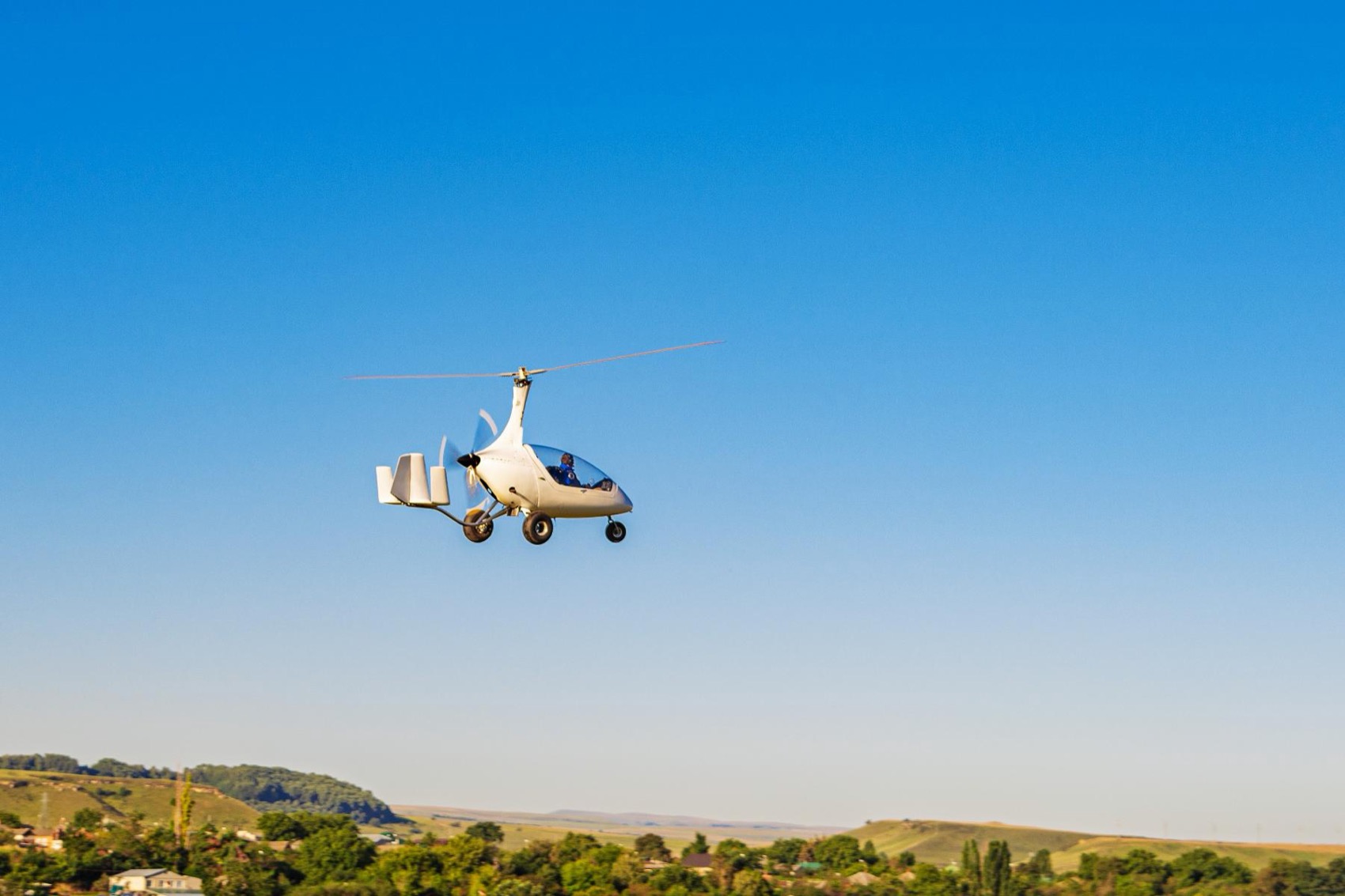
The question comes up because both machines have spinning blades and neither is a helicopter: what is actually the difference between a gyrocopter and a drone, or a quadcopter with a seat? The answer is close to everything. They generate lift on opposite principles, they are regulated as different things entirely, and the jobs they are good at barely overlap. Here is the comparison people are actually reaching for, laid out properly.
The core differences
- A quadcopter's rotors are powered and computer-balanced; a gyrocopter's single rotor is unpowered and spun by airflow.
- A drone hovers by nature; a gyrocopter cannot hover at all.
- A gyrocopter is a certificated aircraft with a pilot aboard; a drone is remotely flown under different rules.
- Kill the power on a quadcopter and it falls. Kill the engine on a gyrocopter and it glides.
Opposite answers to the same problem
A quadcopter stays up by brute force and fast math: four or more powered rotors thrust straight down, and a flight controller adjusts their speeds hundreds of times a second to keep the machine level. Nothing about it is aerodynamically stable; the computer is the stability. A gyrocopter is the opposite philosophy. One large rotor spins unpowered, driven by air flowing up through it as the aircraft moves forward, and the machine is stable because the physics is, no computer required. The quadcopter is a flying robot. The gyrocopter is a minimal aircraft. That single design fork explains every difference downstream.
The consequences of each choice
| Gyrocopter | Quadcopter drone | |
|---|---|---|
| Lift source | Unpowered rotor, autorotation | Powered rotors, computer-stabilised |
| Hover | No | Yes, effortlessly |
| Power failure | Glides down under control | Falls, unless a chute deploys |
| Endurance | Three to four hours on gasoline | Commonly under an hour on batteries |
| Pilot | Aboard, certificated | On the ground, different rules |
| Carries people | One or two | Not the ones you can buy |
The failure mode that separates them
The starkest difference is what happens when the power stops. A quadcopter's lift is its motors; lose them and it is a falling object, which is why serious ones carry ballistic parachutes. A gyrocopter's rotor was never powered in the first place, so an engine failure changes nothing about the lift: the aircraft glides down at its usual steep angle and lands in a small space, as covered in what happens if the engine fails. It is a strange inversion: the machine that cannot hover is the one that handles losing its engine gracefully, and the machine that hovers perfectly handles it worst.
The rules are different worlds
Legally the two barely share a system. A gyrocopter is an aircraft: registered, inspected, flown by a certificated pilot under the same airspace rules as everything else with wings, as laid out in do you need a license. A small drone flies under its own remote-pilot rules, below 400 feet, within sight of the operator, and away from people and aircraft. The gyrocopter can cross a state at 1,500 feet with you aboard; the drone cannot leave its operator's neighborhood. Passenger-carrying multirotors, the "flying car" prototypes, sit in a certification limbo the gyrocopter escaped a century ago.
Why the confusion exists at all
The two get tangled because the eVTOL era borrowed the gyroplane's silhouette. Passenger drones and "flying cars" in the news are multirotors scaled up to carry a person, and from a distance they read as cousins of the gyrocopter. The engineering says otherwise. A scaled-up quadcopter carries its stability in software and its endurance in batteries, and both of those are exactly what regulators are still struggling to certify. The gyrocopter solved the same problem, cheap personal vertical-ish aviation, a century earlier with no software at all, which is why you can buy one today with a straightforward certificate while the eVTOL prototypes are still flying demo circuits. If the flying-car headlines are what brought you here, the machine you can actually own this year is the one this site covers.
Which one you actually want
It comes down to where the camera, or you, need to be. If the job is a ten-minute aerial photo of a roof, a drone does it for a few hundred dollars and no licence beyond a remote-pilot certificate. If the point is being in the air yourself, covering real distance with hours of endurance, or putting human eyes and judgement over miles of pipeline or fence, that is an aircraft's job, and the gyrocopter is the cheapest aircraft that does it well, as the working-uses guide shows. Plenty of operators sensibly own both: the drone for the close look, the gyro for everything past the end of the street.
A drone puts a camera in the sky. A gyrocopter puts you there. They are not rivals so much as different answers to different questions.
If you want the seat, start here
The version with you aboard starts at a demo flight and a look at what the machines cost.
Report inaccurate information. This page mixes public data with our own notes. Tell us what looks off and we will check it.