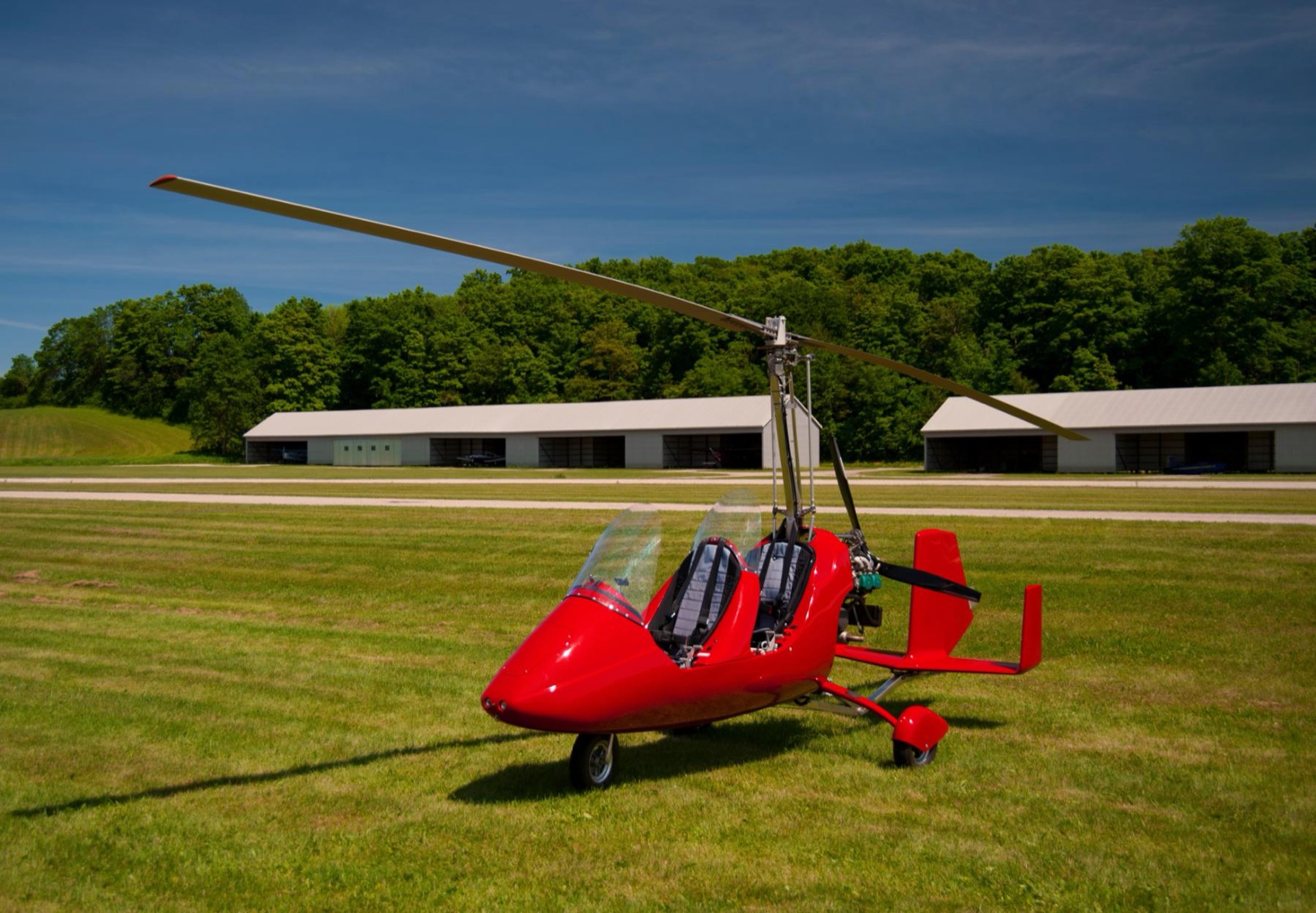
Ask what a gyrocopter is for and most owners will grin and say "flying." That is the honest first answer: the majority of these machines exist for sport. But the same traits that make them fun, slow flight, huge visibility, tiny operating costs, small-field freedom, have quietly built a working resume too, from police patrol in Texas to pipeline inspection to a strange and genuine military history. Here is the full picture.
Where you will find them working
- Sport and recreation, the heart of the market by a wide margin.
- Flight training, patrol and observation work, and aerial photography.
- Agriculture: crop checks, livestock, fencelines over big acreage.
- Law enforcement, most famously the Tomball, Texas police department.
Sport first, and unapologetically
Most gyrocopters are bought to be flown for the joy of it: low, slow evenings over open country, fly-ins, weekend cross-countries at 70 mph with the world in view. The open cockpit and stall-proof rotor make the aircraft feel more like a flying motorcycle than a small airplane, and owners use it the same way, often and casually. Everything else on this page is a side effect of an aircraft that is cheap to run and pleasant to fly slowly. That combination turns out to be useful to more people than hobbyists.
The observation platform nobody prices
Anything that needs slow flight, a good view and a small budget is gyroplane territory. Pipeline and powerline patrol runs for miles at low speed, exactly the regime these machines love. Aerial photographers get a steady, open, slow-moving platform for a fraction of helicopter rates. Ranchers and farmers use them to check crops, water, fences and livestock across acreage that eats a day by truck. Wildlife counts and search support appear in the logbooks too. None of this needs to hover, and everything on the list punishes the hourly cost of the helicopter that could.
The police story worth knowing
The Tomball Police Department in Texas made national news by putting an AutoGyro MTOsport on patrol, and the arithmetic explains why. Their gyroplane cost roughly $75,000 and burns pump gas at about $50 an hour. A police helicopter runs to millions to buy and around $1,000 an hour to fly. For traffic patrol, incident overwatch, photography and event support, a 60-officer department got most of the helicopter's usefulness for roughly a hundredth of the cost, working alongside the county sheriff's office. The trade-offs are real, an open two-seat machine carries less gear and no rescue hoist, but as a set of eyes over a town it is hard to argue with the numbers.
A patrol aircraft for the price of a patrol car, flying on the fuel the patrol car uses. That is the pitch, and Tomball proved it in public.
The military history, briefly
The working gyro is not a new idea. In the Second World War, German U-boats towed the Focke-Achgelis Fa 330, an unpowered rotor kite, to lift a lookout hundreds of feet over the sea, and Japan flew Kayaba Ka-1 autogyros for artillery spotting and anti-submarine patrol. Cierva's Autogiros flew military observation and even landed on a White House lawn between the wars. The helicopter took over those jobs when it matured, but the pattern, cheap slow flight with a good view, is the same one Tomball rediscovered eighty years later.
Training, the quiet workhorse role
A meaningful share of gyroplane hours are flown teaching the next pilots. Two-seat trainers work hard at the handful of US schools, and every one of those hours is also a demonstration flight for the sport. If the fleet grows the way the new rules allow, training will grow first, which is why schools and instructors list free in our training directory and CFI directory.
Could one work for your work?
If you run land, cover territory, or sell a service that needs eyes in the air, the arithmetic is worth an afternoon. The question to ask is not "could a gyroplane do this" but "does this job need to hover or carry weight." If the answer to both is no, and the job is really looking at things from above, then the machine that does it for $50 an hour deserves a quote next to the one that does it for $1,000. US rules put some limits on commercial use depending on the aircraft's certification category, so run the specifics past an instructor or examiner before building a business on one, but ranchers flying their own fences on their own aircraft have been doing exactly this for decades.
What they are not for
Honesty requires the other list. A gyrocopter does not hover, so it cannot do the helicopter's lifting, hoisting and hold-station work. It is not a hauler: two seats and soft bags are the ceiling. It is not a long-range traveller, as covered in gyrocopter vs airplane. The machine's genius is narrow and deep: be in the air cheaply, slowly, and with a perfect view. Every real-world use above is that sentence wearing a different uniform.
See the machines behind the missions
From open patrol-style tandems to enclosed tourers, the aircraft doing all of the above are in the directory.
Report inaccurate information. This page mixes public data with our own notes. Tell us what looks off and we will check it.