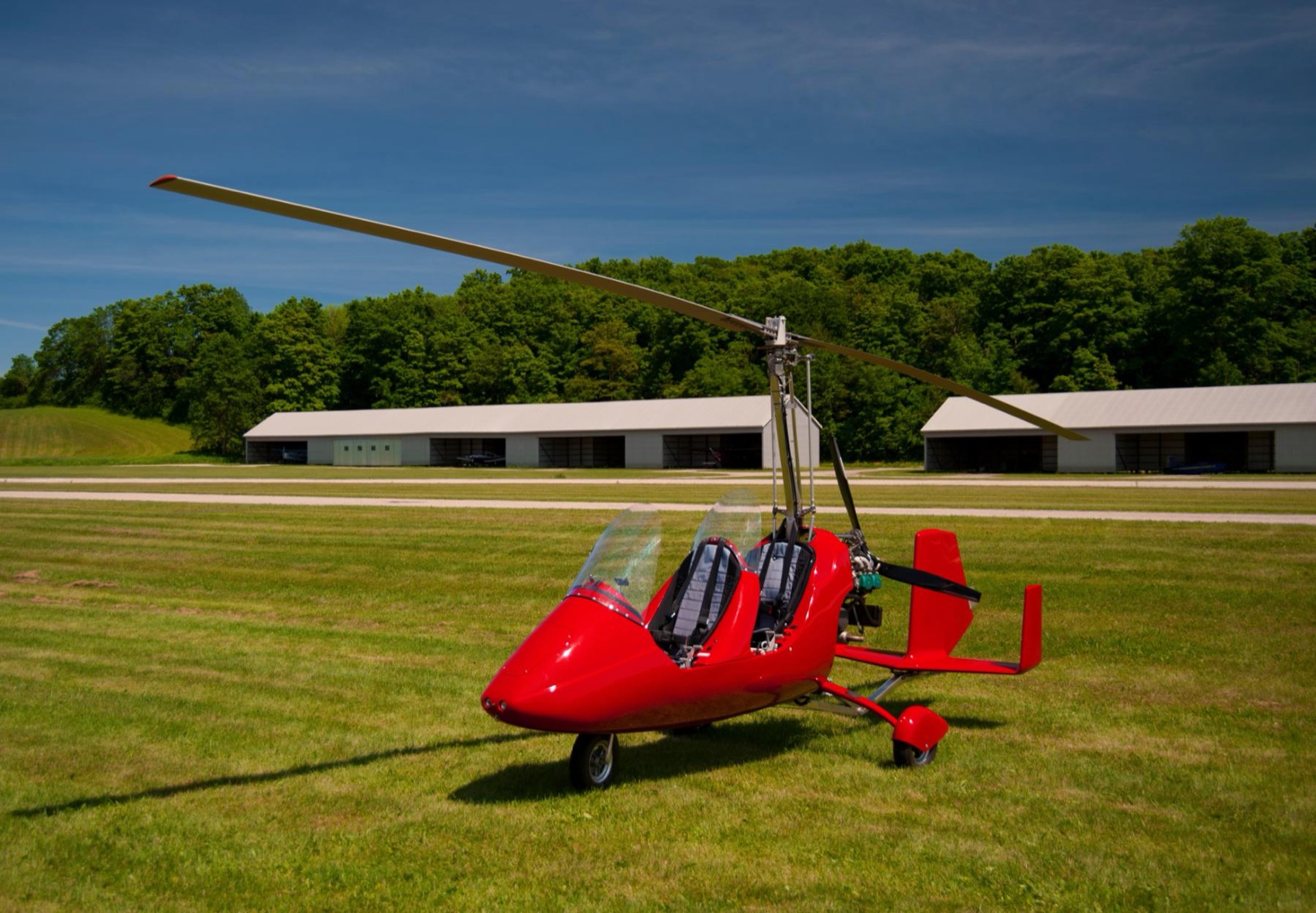
If you searched for how to build a gyrocopter expecting a set of plans and a parts list, the honest answer starts somewhere else. Nobody who wants to keep flying should begin from raw tube stock and a blank sheet the way the earliest builders did. The airframe, the rotor system and the flight characteristics have already been engineered, tested and flown thousands of hours by a real manufacturer. Building today means assembling one of those proven designs, not inventing your own, and the more useful question is who actually makes them.
The two real routes
- Build a kit from an established manufacturer's design, under the US experimental amateur-built rules.
- Buy a factory-certified aircraft, a path the FAA's MOSAIC rule is opening up in the United States for the first time.
What building actually means
A kit gyrocopter arrives as manufacturer-engineered parts, drawings and build support, and your job is assembly: airframe, engine, rotor system, wiring and rigging, tested and signed off at the end. In the United States that machine is almost always certificated as experimental amateur-built, which carries its own rule about how much of the work you personally have to do. We cover that regulation and the full build-versus-buy financial trade-off in building or buying a kit gyrocopter. This piece is about who is behind the kits and the finished aircraft in the first place.
The kit manufacturers
Several manufacturers sell complete, engineered designs as kits or experimental-category aircraft, not a finished factory machine you fly away in.
ELA Aviacion, based in Spain, publishes a Business Class line built around the Eclipse and Eclipse EVO, and a Sport Line built on its 07 range, the Cougar and Scorpion. NIKI Rotor Aviation, a Bulgarian manufacturer established in 2010, builds the Kallithea, the larger Kallithea K2, the Cruiser and the Lightning, all with carbon fuselages and Rotax power. Both publish real specifications for their models on our manufacturer directory, so you can check the numbers instead of taking a dealer's word for them.
The United States has its own long tradition of kit-built gyroplanes, going back decades, with manufacturers such as Sport Copter and Air Command International serving that market. If you are looking at a US kit machine, treat the manufacturer's track record and support network as seriously as the design itself, since parts and technical help matter as much after the sale as before it.
The big boys: factory-certified aircraft
Two manufacturers dominate the factory-built side of the market. AutoGyro, based in Hildesheim, Germany, builds its range on three airframes, the side-by-side Cavalon, the tandem Calidus and the tandem MTOsport 2017, each offered in several mission variants. Magni Gyro, based at Besnate in Italy, builds the M16, M22, M24 and M26, all two-seat designs on a TIG-welded 4130 steel airframe.
| Manufacturer | Country | Known for |
|---|---|---|
| AutoGyro | Germany | Factory-built Cavalon, Calidus, MTOsport |
| Magni Gyro | Italy | Factory-built M16, M22, M24, M26 |
| ELA Aviacion | Spain | Kit and experimental Eclipse, Cougar, Scorpion lines |
| NIKI Rotor Aviation | Bulgaria | Kit and experimental Kallithea, Cruiser, Lightning |
| Sport Copter, Air Command International | United States | Long-standing US kit tradition |
Until recently these two categories were kept apart by regulation as much as by choice. A factory could not sell a ready-to-fly, certified gyroplane in the United States at all, which is a large part of why the experimental route dominated here. The FAA's MOSAIC rule changes that, opening a light-sport certification path for factory-built gyroplanes. We cover exactly what changed in the MOSAIC rule and gyroplane flight training.
A manufacturer's home-country certification does not automatically transfer. The same design can be certified in Europe and registered as experimental in the United States, and which category an aircraft actually holds changes what you can do with it and who can maintain it. Confirm the category of any specific aircraft, not just the brand behind it.
How to actually choose one
Skip the marketing and check four things instead: whether the manufacturer publishes real, checkable specifications, whether an instructor near you actually teaches that type, whether parts and support exist in your country, and how the design compares against the others you are considering. Our gyrocopter finder matches your mission and budget against the published data for every model on file, and the comparison tool puts any two side by side. Neither replaces a demonstration flight, but both save you from guessing at specs a brochure would rather round up.
See every manufacturer side by side
Browse the full directory, or answer a few questions and let the finder shortlist the models that actually fit your mission.
Report inaccurate information. This page mixes public data with our own notes. Tell us what looks off and we will check it.