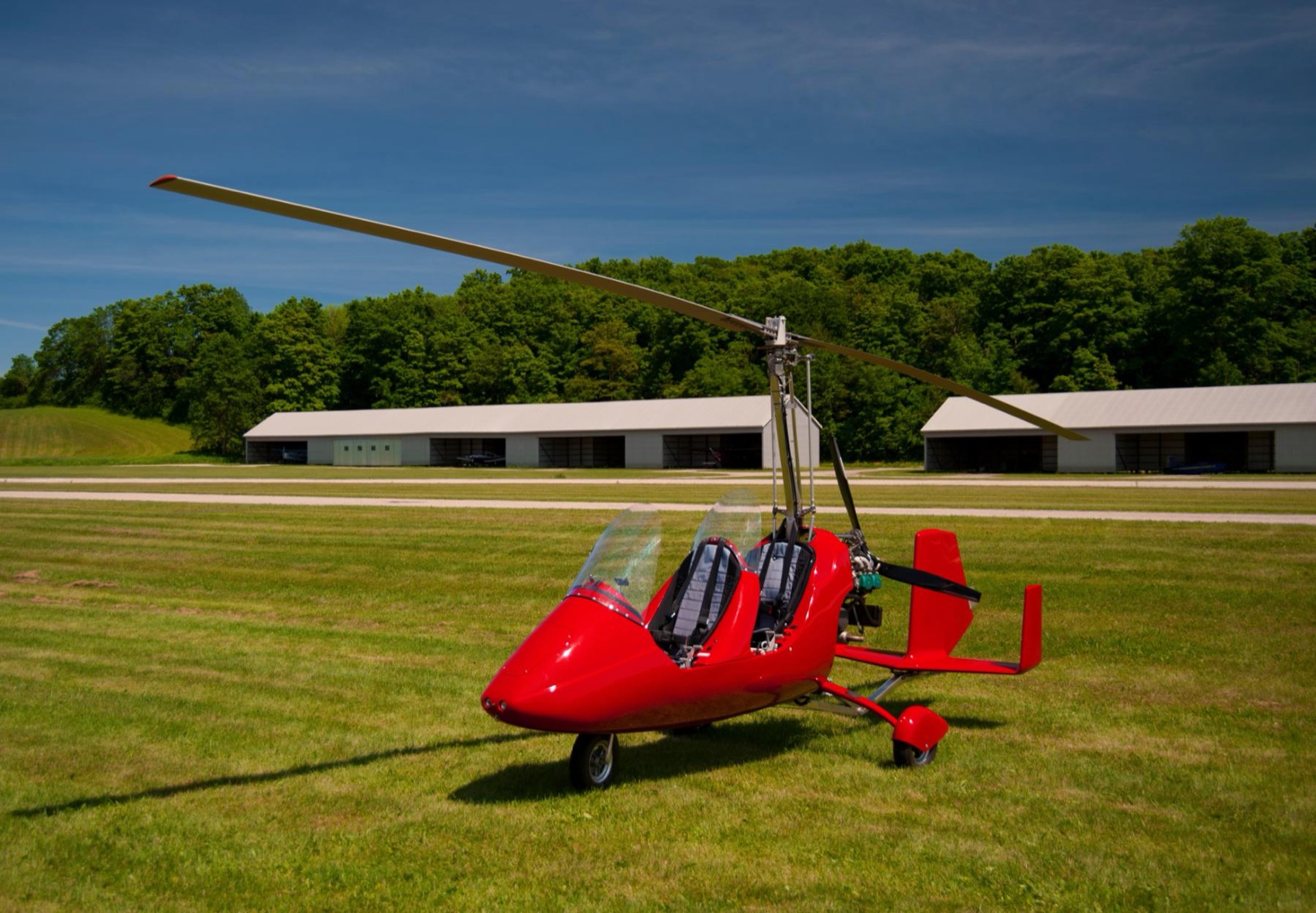
The gyrocopter has one inventor and one reviver, and the gap between them is most of the twentieth century. A Spanish engineer built the first working machine in the 1920s to solve a problem that was killing pilots. An American put it in a kit and sold it to the masses thirty years later. The aircraft you can buy today descends from both.
The short history
- Juan de la Cierva flew the first successful gyroplane in Spain in 1923.
- His breakthrough was the flapping hinge, which made the spinning rotor controllable in forward flight.
- The helicopter eclipsed it in the 1940s, and the machine nearly vanished.
- Igor Bensen revived it as a cheap homebuilt in 1950s America and coined the word gyrocopter.
Juan de la Cierva and the problem he was solving
Cierva was not chasing a novelty. He had watched a fixed-wing aircraft of his own design stall and crash, and he set out to build something that could not stall. His answer was a freely spinning rotor that kept making lift even when the aircraft slowed right down. His first three attempts failed for a reason nobody had solved: in forward flight the blade advancing into the wind makes far more lift than the one retreating, and that imbalance rolled the aircraft over.
The fix, fitted to his fourth machine, was elegant and is still on every one of these aircraft today. He hinged each blade so it could flap up and down freely. The advancing blade rose and shed its excess lift, the retreating blade dropped and kept its own, and the imbalance cancelled itself out. On the 17th of January 1923, that machine, the C.4, flew at Getafe near Madrid. It was the first practical rotary-wing aircraft of any kind, helicopters included.
Cierva called his invention the Autogiro, spelled with an i, and trademarked it. That is why older books say autogyro and your paperwork says gyroplane and the advert says gyrocopter. They are the same machine, renamed by whoever was selling it. I untangle the three names in gyroplane vs gyrocopter.
The decades in the wilderness
Through the 1930s the Autogiro had a real run. Cierva licensed the design widely, the machines carried mail and flew military observation, and one even landed on the lawn of the White House. Then two things ended the moment. Cierva himself died in 1936, a passenger in a fixed-wing airliner that stalled on takeoff, a grim irony given what he had built. And by 1939 Igor Sikorsky had flown a practical helicopter, which could do the one thing the gyroplane never could: hover. For military and commercial buyers that settled it, and the gyroplane slid toward obscurity.
Igor Bensen and the machine for everyone
The revival came from a different direction entirely. Igor Bensen, a Russian-born engineer who had worked on rotorcraft in American industry, founded Bensen Aircraft in Raleigh, North Carolina, in 1953. His genius was not aerodynamic, it was commercial: he stripped the gyroplane down to a bare open frame, a seat, an engine and a rotor, and sold it as a kit you built in your garage. He coined the word Gyro-Copter for it, and the B-8M that followed became one of the most popular homebuilt aircraft of the century, with kits selling by the thousand from the mid-1950s into the 1970s.
| When | What | Why it mattered |
|---|---|---|
| 1923 | Cierva C.4 flies | First practical rotary-wing aircraft; the flapping hinge |
| 1930s | Autogiro in service | Mail, military observation, public fascination |
| 1939 | Practical helicopter | Hovering flight eclipses the gyroplane |
| 1950s | Bensen B-8M kit | Cheap homebuilt puts it within reach of anyone |
| 2000s | European factory machines | Modern, safer designs revive the category |
From garage frame to the machines we sell now
Bensen democratized the gyrocopter, but the early homebuilts also earned the aircraft its dangerous reputation, for reasons of geometry I cover in the safety guide. The machine you would actually buy today comes from a later chapter: from the 2000s onward, European manufacturers, chiefly in Germany and Italy, built enclosed, factory-made gyroplanes with the design flaws engineered out. That is the lineage that runs through the aircraft in our directory. The idea is Cierva's, the accessibility is Bensen's, and the safety is modern.
The gyrocopter's brush with fame
The aircraft never quite lost its cult following, and it had its Hollywood moment. In Britain, Wing Commander Ken Wallis built and flew a long line of tiny single-seat autogyros and set world records in them. One of his machines, fitted with mock weapons and christened Little Nellie, flew in a 1967 James Bond film, and that image of a nimble one-man rotorcraft darting through mountains did more for the public idea of the gyrocopter than any brochure ever could. It also helped cement a misconception, that these are exotic, twitchy machines, when the modern factory reality is closer to a friendly, forgiving sport aircraft that happens to have a spinning wing.
See where the story leads
A century after Cierva, the descendants of that first machine are for sale from factories around the world. Browse who makes them now.
Report inaccurate information. This page mixes public data with our own notes. Tell us what looks off and we will check it.