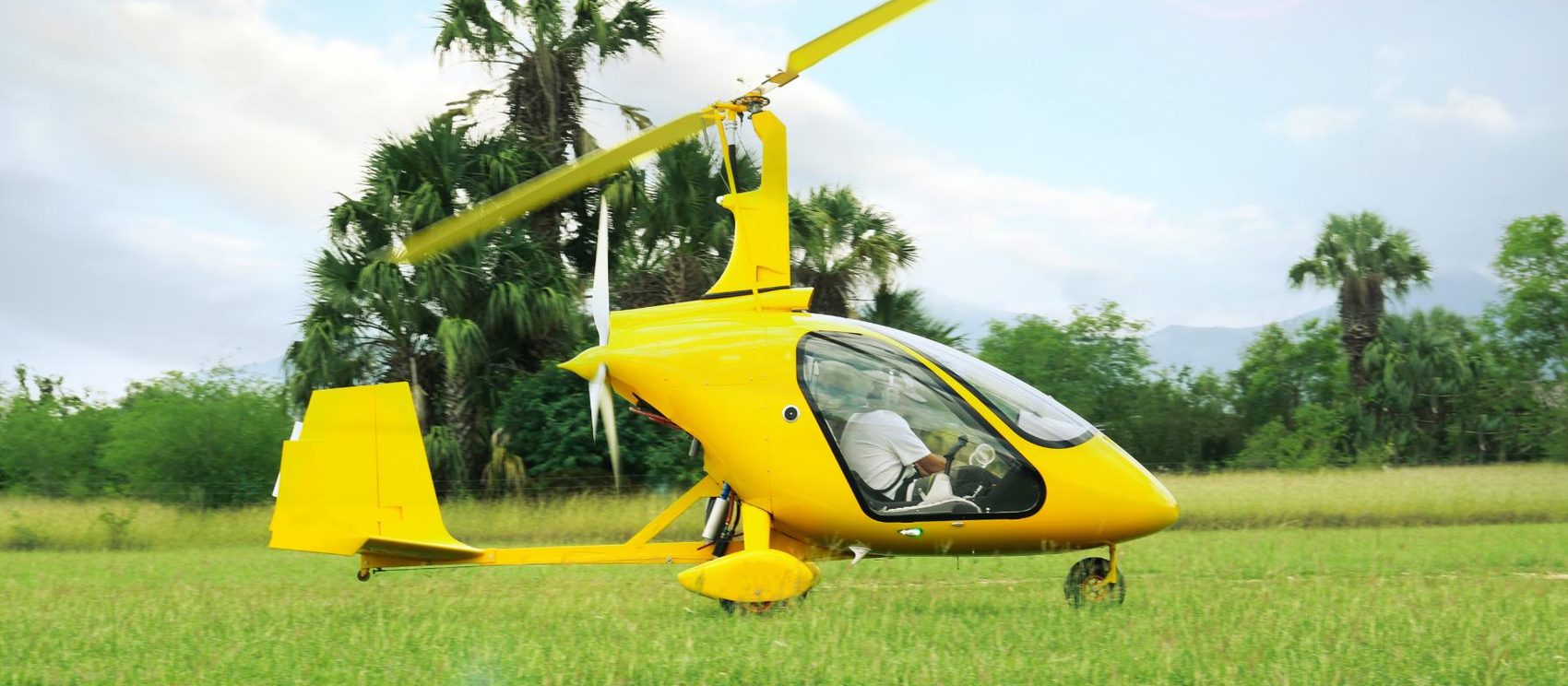
A gyrocopter needs surprisingly little room. Depending on the machine and the day, a takeoff run is often a few hundred feet, and a landing into any decent wind can be measured in a single-digit number of steps. That short-field ability is one of the aircraft's genuine superpowers, and it is worth understanding why the numbers land where they do.
The short version
- Takeoff runs are commonly in the low hundreds of feet, far shorter than a light airplane.
- Landing into wind can need almost no ground roll at all.
- A pre-rotator spins the rotor up first, which is what makes the short takeoff possible.
- Weight, temperature, wind and surface all move the numbers, so the flight manual figure is the one that counts.
Why the takeoff is so short
A gyroplane cannot simply floor it and go, because its rotor has to be turning fast enough to fly before the wheels leave the ground. The pre-rotator solves that: it spins the rotor up to a few hundred rpm while you sit still, so the ground roll only has to finish the job, not start it. With the rotor pre-spun, some light single-seat machines break ground in as little as 75 to 200 feet, and a typical two-seater's manual might quote something around a hundred meters on a still day. As a rough planning figure, many owners treat five hundred feet as comfortable, and then watch it shrink in a headwind.
Why the landing is shorter still
This is where the aircraft shows off. Because it cannot stall and can fly extremely slowly, a gyroplane can descend at a steep angle and, flared into a headwind, touch down with little or no forward roll at all. Pilots routinely put these machines down in a distance that would be impossible in a fixed-wing aircraft. It is not a true vertical landing, the aircraft still flies an approach and a flare, but into a good breeze it comes close enough to feel like one.
Wind is the variable that changes everything, and it does so in your favor. A gyroplane flies at low speed, so a headwind that a fast airplane barely notices can cut the ground roll dramatically at both ends. The same low speed is why these machines are so at home operating from small strips: a stiff breeze that grounds nervous fixed-wing pilots is often exactly what makes a gyro's day.
What moves the numbers
| Factor | Effect on distance |
|---|---|
| Headwind | Shortens both takeoff and landing, often a lot |
| Weight, two up with fuel | Lengthens the takeoff run and softens the climb |
| Heat and altitude | Thin air lengthens the run |
| Surface | Long grass or soft ground drags the run out |
| Pre-rotation rpm | More rotor speed before rolling means a shorter run |
Real numbers, with the honest caveat
Put figures on it and the picture sharpens, as long as you remember they are starting points and not promises. A light single-seat machine with a good pre-rotator can be airborne in well under two hundred feet. A loaded two-seater on a warm, still day is more honestly planned around a few hundred feet, which is why five hundred makes a comfortable working number. Landings, into any useful headwind, routinely need a fraction of that. The only figures that actually bind you are the ones in your aircraft's flight manual, measured for that machine at a known weight, and those are the ones to plan against, not anything you read on a page like this one.
Why the short landing is a safety feature, not a party trick
The short-field ability is not just convenient, it is one of the reasons the aircraft is reassuring to fly. Because a gyroplane needs no ground roll to land when the engine has quit, an engine failure becomes a controlled glide to almost any small clearing, not a scramble for a runway you might not reach. A fixed-wing pilot in the same situation needs a field long enough to roll out on. A gyroplane pilot needs somewhere to stop. That difference, born of the same physics that makes the takeoff short, is a large part of why owners trust these machines down low, close to the ground where the flying is best.
What this does not mean
Short is not the same as vertical. A gyrocopter still needs that forward roll to build airflow through the rotor, so it cannot leap straight up off a standstill the way a helicopter can, a point I cover in can a gyrocopter hover. What the short-field ability really buys you is options: more places to operate, more fields you can use, and a huge margin if the engine ever quits, since a power-off landing needs no roll at all. The mechanics behind all of it are in how a gyrocopter works.
See which machines suit small strips
Takeoff and landing performance vary by model and engine. Compare what each manufacturer publishes for its aircraft.
Report inaccurate information. This page mixes public data with our own notes. Tell us what looks off and we will check it.