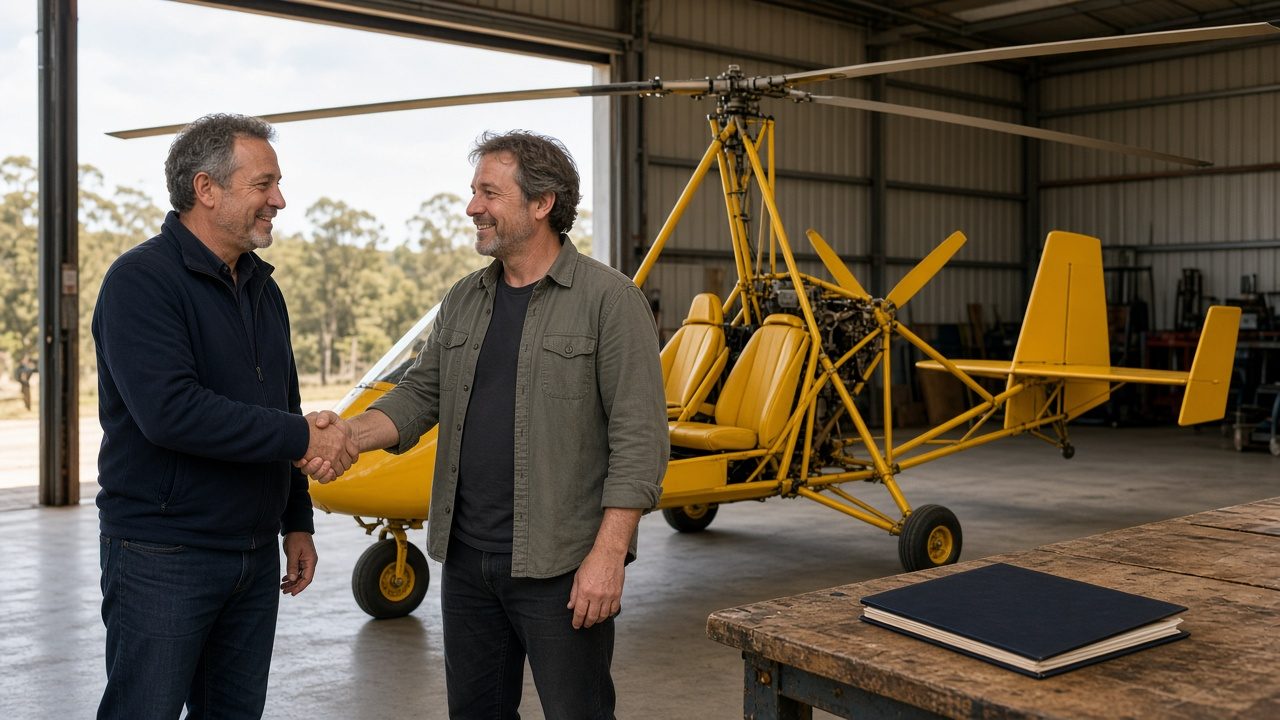
Gyroplane financing uses the same four paths as any light aircraft: a secured loan, cash, a co-ownership partnership or a flying club. What differs is how each path treats a gyroplane, which a lender may file under "rare" or "experimental," and which federal rule ends up limiting the deal.
A loan is realistic if your finances and the aircraft's paperwork are clean. Cash is simplest but skips none of the due diligence. A partnership needs registry-compliant ownership. A club runs into the rules on compensation and on leasing experimental aircraft before anything else.
The short version
- AOPA Aviation Finance lists a minimum 15 to 20 percent down payment, 18 months of payments in liquid assets and a credit score of no less than 700.
- Lenders say experimental or rare aircraft may need different down payments, rates or financing structures, and logbook completeness affects terms.
- A partnership can register an aircraft only if every partner is a US citizen. Co-ownership outside a partnership has more room.
- Some experimental airworthiness certificates cannot be leased at all, which breaks the usual club rental model.
- A financed aircraft needs hull and liability insurance with the lender named as loss payee.
Each money path has one rule that bites hardest
The friction comes from the aircraft, not the money. A lender sizing up a gyroplane looks at the same things it looks at for any airplane, and AOPA's finance team says experimental, rare or multi-engine aircraft may need different down payments, rates or financing structures. Depending on how it is certificated, a gyroplane can tick one or both of the first two boxes. Our gyroplane financing overview covers lender contacts; this piece is about which path fits and what limits it.
| Path | Who carries the risk | What bites |
|---|---|---|
| Secured loan | You and the lender | Down payment, liquidity and credit minimums; complete logs; hull and liability insurance with the lender as loss payee |
| Cash | You alone | Clean title, seller lien release, records review; registration renewal every seven years |
| Partnership | Each co-owner | Partnership registration requires every partner to be a US citizen |
| Club | Members and the owning entity | Private pilot compensation limits; no leasing of experimental aircraft certificated under § 21.191(i), (k) or (l), with narrow exceptions |
- If your credit, liquidity and down payment clear the minimums and the logs are complete, then a secured loan is realistic. Start with pre-approval.
- If the aircraft carries an experimental certificate or has gaps in its logbooks, then expect a lender to push back on terms.
- If one of your intended co-owners is not a US citizen, then a formal partnership cannot register the aircraft, and you need a different ownership structure.
- If the plan depends on renting the gyroplane to others, then check the airworthiness certificate first, because some experimental certificates cannot be leased.
A loan works when the logbooks are as clean as your credit
AOPA Aviation Finance compares buying an aircraft to buying a house rather than a car, and its baseline is blunt: at least a 15 to 20 percent down payment, 18 months of payments in liquid assets and a credit score of no less than 700 to be considered. Expect to hand over tax returns, business financials and personal net worth information. The simpler your income documentation, the easier the decision.
What the lender wants from you
Lenders look at income, debt, liquidity and credit history, and they want to see you can carry the payment plus insurance, maintenance, fuel and storage. Run those numbers in the ownership cost calculator before you talk to anyone. AOPA's team says first-time buyers and student pilots can often qualify, but lenders prefer a logical progression in ownership. A simple first aircraft is an easier story than an ambitious one.
What the lender wants from the aircraft
Aircraft type, number of engines, damage history and logbook completeness all influence terms. At closing, complete logs are typically required, with some exceptions for aged aircraft. A gyroplane with a missing year of maintenance entries is a harder loan than one with a tidy paper trail, no matter how nice the rotor blades look.
Watch for: the lender requires hull and liability coverage with the lender named as loss payee, in place before the planned closing date. Start the application early. Our gyrocopter insurance guide covers what drives the premium.
AOPA says approval typically takes 1 to 2 business days after a completed application, then another 5 to 7 business days to close; a second buyer can stretch that. Pre-approval locks a rate for 30 days and is good for 90 days. Closing needs a properly executed bill of sale, application for registration and security agreement. Common delays are clouds on title, slow seller lien releases and Airworthiness Directives that take longer than expected.
How you plan to fly it shapes the loan terms
Lenders sort aircraft into two buckets. AOPA's finance team explains that personal-use aircraft are treated as nice-to-have assets, while charter or leaseback aircraft are working assets. Nice-to-have aircraft depreciate more slowly and predictably and can be sold in a default without disrupting a business, which often earns longer amortization and lower down payments.
Working assets wear harder and lose value faster. AOPA warns that switching to charter or leaseback mid-deal can worsen terms significantly, and borrowers can end up owing more than the aircraft is worth within a few years. Keep that in mind before financing a gyroplane and quietly placing it with a club or school to cover the payment.
Tell the lender the real mission on day one. Changing it after closing is how a sensible loan turns upside down.
Cash skips the lender, not the homework
Paying cash removes the down payment math, the credit pull and the loss-payee requirement. It does not remove the reasons a lender asks for those things. You still want a professional pre-buy inspection, a review of every logbook and a title search showing no clouds and a released lien. A lender would catch a missing lien release. A cash buyer has to catch it alone.
Under 14 CFR Part 47, a Certificate of Aircraft Registration costs $5.00, expires seven years after the last day of the month it was issued, and can be renewed during the six months before expiration for another $5.00. Put the renewal window on your calendar.
Without a lender, insuring your equity is your call. If you buy hull coverage, AOPA's insurance partner notes it is written on an agreed or stated value basis. Under-insure and a moderate loss can be declared a total loss, which also transfers the salvage, upgrades included, to the insurer. Update the stated value when you add equipment. For price ranges, see what a gyrocopter costs new, used and to own.
Partnerships split the bill and multiply the signatures
Co-ownership is a common way to make an aircraft affordable, and Part 47 is where it gets technical. A partnership may register an aircraft only if each partner, general or limited, is an individual US citizen. The same rule says an aircraft co-owned by resident aliens, or by resident aliens and citizens together, is not ineligible as long as it is not owned as a partnership asset. Which structure suits your group is a question for an aviation attorney, not a hangar conversation.
- 1
Choose the ownership structure
Formal partnership, co-owners or an entity. That choice drives registration eligibility and how a lender views the deal.
- 2
Confirm every owner's eligibility
One non-citizen partner disqualifies a partnership registration. Check before money moves.
- 3
Write down the money terms
Who pays the hangar, inspections, the deductible and engine reserves, and how a partner exits.
- 4
Sign the registration correctly
Each signer signs in ink or by another FAA-accepted means, with a typed or printed name in the signature block if signed in ink.
If the group borrows, expect a slower close. AOPA notes that more than one partner purchasing the aircraft can add time.
Clubs run into the compensation and leasing rules first
A club usually means an entity owns the gyroplane and members pay to fly it. That payment is where the regulations start. Under 14 CFR 61.113, a private pilot may not act as pilot in command for compensation or hire, with listed exceptions, and on flights with passengers may not pay less than the pro rata share of operating expenses limited to fuel, oil, airport expenditures or rental fees.
The bigger wall is in 14 CFR 91.319. No person may lease an aircraft with an experimental airworthiness certificate issued under § 21.191(i), (k) or (l), except for glider towing under the rule's own terms or a solo flight in a training program under § 91.326(b). Experimental aircraft also cannot carry persons or property for compensation in operations that need a Part 119 certificate. Every passenger must be told the aircraft is experimental, and operations are VFR, day only, unless the FAA authorizes otherwise.
The messy middle: which paragraph of § 21.191 a given gyroplane was certificated under decides whether a club can rent it at all. Pull the airworthiness certificate and operating limitations before forming anything, read our explainer on light-sport and experimental gyroplane certification, and ask the FAA to confirm the club structure.
And remember the lender's view: an aircraft flown by many members starts to look like a working asset, with tighter terms to match.
Frequently asked questions
Can you get a loan on an experimental gyroplane?
Possibly. AOPA's finance team says experimental, rare or multi-engine aircraft may require different down payments, rates or financing structures, and every loan is evaluated individually. Logbook completeness and damage history matter too. Ask a lender early with the year, make and model; pre-approval through AOPA Aviation Finance locks a rate for 30 days and is good for 90 days.
How long does an aircraft loan take to close?
AOPA Aviation Finance says approval typically takes 1 to 2 business days once a completed application is submitted, then another 5 to 7 business days to close. A complicated financial package or a co-buyer can stretch that. Hold off on travel plans to collect the gyroplane until the lender confirms the closing date.
Do I need hull insurance if I pay cash?
The hull and liability requirement comes from the lender, so it leaves with the lender, and insuring your own equity becomes your decision. If you do, hull is written on an agreed or stated value basis. Set that value carefully and update it after upgrades, because a total loss transfers the salvage, equipment included, to the insurer.
Can club members split the cost of flying a gyroplane?
Ownership cost splits belong in a written agreement. For flights with passengers, 14 CFR 61.113(c) says a private pilot may not pay less than the pro rata share of operating expenses, limited to fuel, oil, airport expenditures or rental fees. Renting an experimental gyroplane to members raises the separate leasing limits in 91.319.
Report inaccurate information. This page mixes public data with our own notes. Tell us what looks off and we will check it.