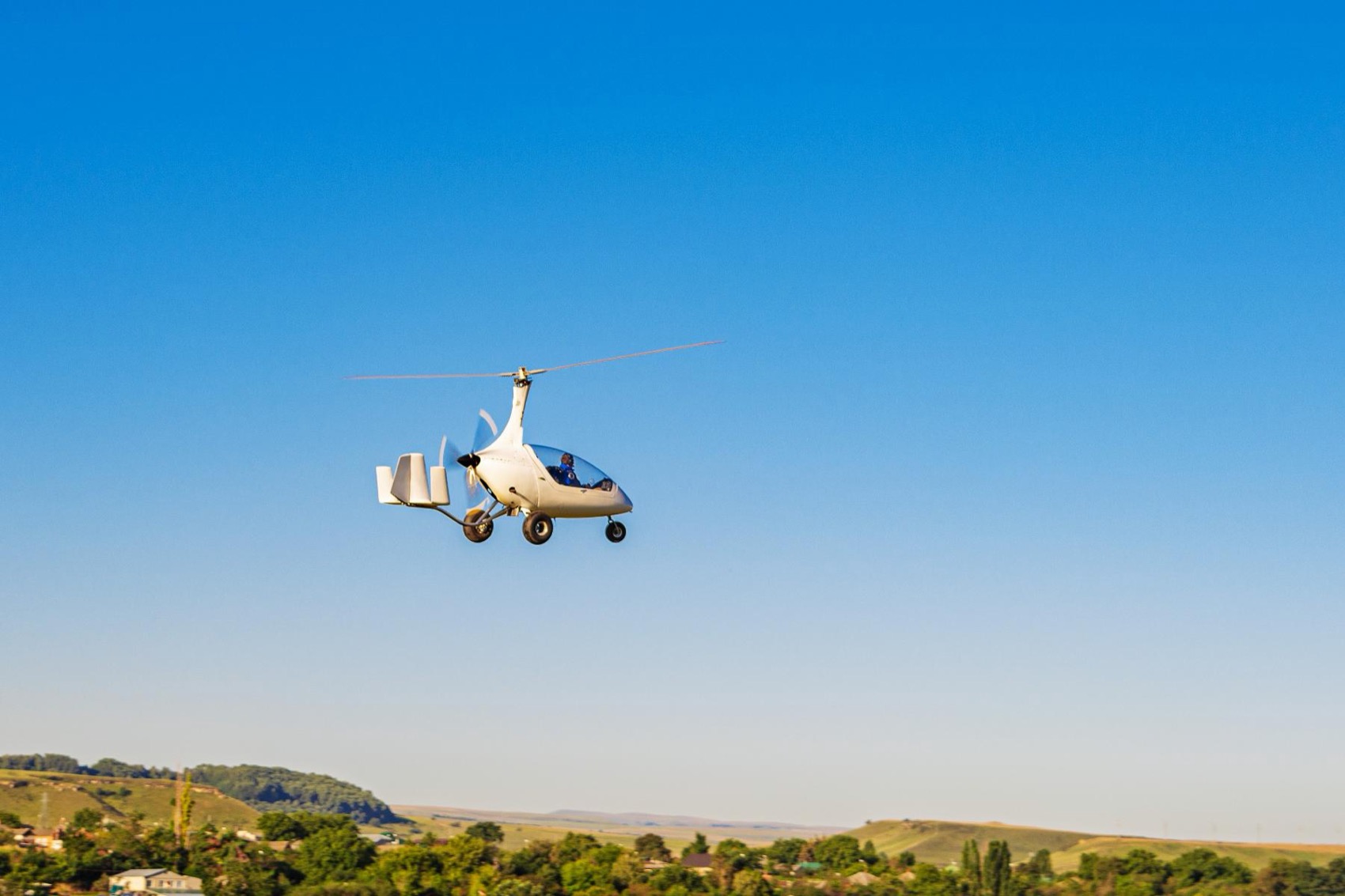
If you are picturing a car cabin, recalibrate before you shop. Comfort in a gyrocopter is a real question with a real answer, and the answer splits cleanly on one decision you make before you ever look at an equipment list: open cockpit, or enclosed. Everything else, heat, weather protection, where your gear goes, follows from that one choice.
The honest version
- Open-cockpit models have no cabin and no heat. You dress for it instead.
- Enclosed-cabin models commonly offer cabin heat, confirmed per model.
- Air conditioning is essentially absent across the category.
- Storage and creature comforts are minimal. This is a flight instrument, not a road trip.
Open cockpit: you dress for it, you do not heat it
An open-frame gyrocopter has no cabin at all, just a seat, a frame and the sky. There is no heater to speak of, so pilots dress the way a motorcyclist or a skydiver would, a real jacket, gloves and a full-face helmet, matched to the season and not left to the aircraft to solve. For a lot of pilots that exposure is exactly the appeal, not a shortcoming, and it is a large part of why the open gyrocopter still has a following alongside the enclosed factory machines. We cover the aerodynamics either layout shares in how a gyrocopter works.
Practically, that means treating your gear list the way a motorcyclist would, not the way a car owner would. A good helmet, a windproof jacket rated for the coldest leg of the flight and real gloves are not optional accessories on an open frame, they are the entire climate system. Pilots who fly open frames regularly tend to layer for the coldest point of the flight, not the ground temperature at departure, since altitude alone can drop the air meaningfully colder along the way.
Enclosed cabins: where real cabin heat lives
Several models on our directory are built with an enclosed cabin instead of an open frame. AutoGyro's Cavalon and Calidus, Magni Gyro's M24 Orion, the whole NIKI Rotor Aviation range, the Kallithea, Kallithea K2, Cruiser and Lightning, and ELA Aviacion's Eclipse and Eclipse EVO all put a real windshield, doors and a cabin between you and the weather. Cabin heat is a common feature on enclosed designs in this class, standard on some, optional on others, so confirm the exact equipment on the specific aircraft's equipment list or flight manual, do not assume every unit off the line carries it. Browse the manufacturer directory to check a specific model's published configuration.
Cabin heat and weather protection are not the same thing as climate control. An enclosed cabin keeps the wind and cold off you far better than an open frame does. It is not sealed and conditioned the way a car is, and treating it as though it were is where a buyer's expectations and the actual aircraft part ways.
What is genuinely absent
Air conditioning is not something this category carries. The weight, power draw and complexity of a real AC system do not make sense on an aircraft this light, so an enclosed cabin on a hot afternoon is warm, not cooled. Opening a vent or a window on the ground before departure, and using the aircraft's own forward speed once airborne, is the practical answer most enclosed models rely on instead. That interacts with a separate question, how the aircraft performs in the same heat, which we cover on its own in how gyrocopters perform at high density altitude. Cup holders and cabin storage are minimal to none as well. Plan to carry a headset, water and a flight bag the way you would for any small aircraft, not the way you would pack a car.
None of this is a defect against some other standard the category is supposed to meet. A gyrocopter, open or enclosed, is built around the rotor, the engine and the structure that keeps both flying, and everything else is secondary to that. Buyers coming from a car, or even from a fixed-wing airplane with a real HVAC system, are the ones most likely to be caught off guard, so it is worth setting that expectation before the first demonstration flight, not partway through it.
Deciding which layout is actually right for you
This is a real fork in the buying decision, not a minor spec. Someone who wants the wind and the full sensation of flight is often happiest in an open frame. Someone planning real cross-country trips, cold-weather flying, or simply a warmer cabin on a long day is usually happier enclosed. Our gyrocopter finder asks this question directly and matches your answer against every model on file, so you are choosing based on your own mission, not a brochure photo.
Find the layout that fits your mission
Answer a few questions and see which published models actually match what you want to fly.
Report inaccurate information. This page mixes public data with our own notes. Tell us what looks off and we will check it.